
Bee Keeping 101: Honey Bee Roles & Stages
- Penn State Extension & JS

- Apr 7, 2020
- 8 min read
Updated: Apr 9, 2020

Honey Bee Roles


The Queen
The queen is the only sexually developed female in a hive, and her primary responsibility is reproduction.
The queen is the mother of the hive. Her primary purpose is to lay eggs so the hive always has enough workers to keep things running. Every egg in a hive comes from the queen. Workers don't have fully developed sex organs, so they aren't fit for that job. At peak times, the queen may lay 1500 eggs per day! Queens can live 3 to 4 years too, maybe 5, so you can imagine how valuable it can be to have a good and productive one.
The Role of the Queen
The royal jelly fed to the queen throughout her larval life is primarily responsible for her development as a queen. Before being fed this special diet, a queen egg is identical to a worker egg.
About a week after emerging from her cell, a new queen will leave the hive to mate. She flies to a drone congregating area some distance from her hive where drones from other hives wait for the opportunity to mate with a queen. Here she is unlikely to mate with drones from her own colony--nature's way of increasing genetic diversity.
The queen will mate with an average of 12 drones in the air during each mating flight, which typically occurs over 2 to 4 days. She then immediately heads back to the hive. She will begin laying eggs in about 48 hours. If because of weather or other circumstances she is not able to make her mating flight within 20 to 30 days, she will lose the ability to mate and will only be able to lay unfertilized eggs, which will all become drones. Since drones can't do much for a hive, this situation is unsustainable and the hive will eventually die off if a new viable queen is not introduced.
If she is not able to make her mating flight within 20 to 30 days, the queen will lose the ability to mate and will be able to lay only unfertilized eggs.
Pheromone Production
Another function of the queen is to produce and release pheromones, one of which is called "queen substance." These pheromones serve as societal cues that other bees understand, and the scents hold the colony together and ensure that each member of the colony knows its place.
When a queen starts to fail, her pheromone production diminishes and workers recognize this diminishment as a sign to prepare for supersedure, or replacement of the queen. When a queen is superseded by one of her daughters, mother and daughter may live in the hive together for a period of time. It is one of the rare instances when two queens can be found in a hive.
Identifying the Queen
Many beekeepers paint the back of the queen's thorax a bright contrasting color to allow for easier identification in the bustling hive.
Adult queens are identifiable by their elongated abdomens. A queen's enlarged abdomen makes her wings appear to be shorter relative to her body than the wings of either workers or drones. A queen's wings may cover only about 2/3 of her abdomen when folded back, while the wings of workers and drones will nearly reach the tips of their abdomens.
Many beekeepers paint the back of the queen's thorax a bright contrasting color to allow for easier identification in the bustling hive.
Drones
Male honey bees are called drones. The purpose of the drone is to mate with the queen.
Drones are male honeybees. They only serve one purpose in the hive, and that is to fertilize the queen. They can't protect the hive because they don't have stings, they don't seem to know how to clean up the hive, and they can't even eat on their own for the first several days of their existence -- they have to be fed by the workers. Furthermore, as soon as they do the one thing they are able to do, mate with the queen, they die! And if they don't get so lucky at the end of the summer, the workers literally push them out of the hive to die.
Role of the Drone
Drones are the largest bees in the colony, looking rounder or stouter than workers. They have much larger heads than either queens or workers, and their compound eyes take up a larger percentage of their heads, meeting at the top. Drones have no wax glands, pollen baskets, or stings, and they don't appear to do much work inside the hive.
Despite their lack of participation in the day-to-day operation of a colony, drones seem important for the normal functioning of a colony.

The sole purpose of the drone is to mate with a queen.
The sole purpose of all drones is to try to mate with a virgin queen, although few of them actually get that opportunity. Once they are fully mature, drones leave the hive and gather together in drone congregation areas, where they wait for virgin queens. They will chase after these queens and attempt to mate in flight. The few that are successful die immediately after copulation. In the process of mating, part of the drones endophallus remains lodged in the queen. This is called the mating sign and is removed by the workers when she returns to the hive.
Drones are pushed out of the colony at the end of summer.
Because of their size, drones eat more than workers do. At the end of summer as pollen and nectar sources start to dry up and the colony prepares for winter, workers push the defenseless drones out of the colony, where they will soon starve. Drones have never been observed foraging for food on flowers. They can't live a solitary life. Curiously, though, queenless colonies will allow drones to stay indefinitely.
Worker Bees
Workers are sexually undeveloped female honey bees. Workers are smaller than drones and queens and do almost all the work in a colony. Workers have specialized body structures and organs that allow them to do things like:
· Feed larvae
· Polish cells
· Clean the hive
· Take care of the queen
· Build wax combs
· Guard the entrance to the hive
· Ventilate the hive
· Forage for food, water, and resins for making propolis
During foraging season, workers live for about six weeks, although their life span appears to be more dependent on flight miles than on time. Workers that emerge in the fall can live up to six months, helping the colony survive the winter and rearing new workers in the spring.
Worker bees are all females and they keep everything running smoothly in the hive. They draw out the comb, prepare the cells for the queen to lay her eggs, take care of the larvae, clean up debris inside the hive, protect it from invaders, go get nectar and pollen and water and come back and make honey... they aren't called workers for nothing! The life of a honeybee occurs in a series of stages. There are three stages in the cell, the egg, the larva, and the pupa, then once they emerge from their cells as adult bees, they go through more stages, which are dependent on the age of the bee and the needs of the colony. In chronological order as they age, the roles they fill are nurse bees, house bees, and finally foragers or field bees.
Roles of the Worker
Worker bees go through three stages of life, with different roles in each stage depending on their age and the needs of the colony:
1. Nurse bee stage
2. House bee stage
3. Forager stage
Nurse Bee Stage
Is it the nurse bee's job to feed other worker bees when they first emerge from their cells as adults. Nurse bees usually begin working to clean cells by removing the cocoons and excreta of recently hatched bees. On about the third day, worker bees will begin nursing or feeding brood. They will do this for a week or two, depending on conditions.
The nurse bees feed "royal jelly" to newly hatched larvae. Royal jelly is a special food secreted from mandibular and hypopharyngeal glands in their heads. After the second day of larval development, worker and drone larvae receive brood food. Brood food is a mixture of the hypopharyngeal component, pollen, and nectar.

A nurse bee attends to a developing larva.
When adult worker bees first emerge from their cells, they're called nurse bees. Their first task is cleaning the cells in the brood nest, preparing them for the new eggs. While doing this, they consume a large amount of pollen that activates their food glands, preparing them for their next role, feeding larvae. For the first three days of the larvae's existence, the new workers feed them royal jelly, which is a nutrient-rich substance bees are able to secrete from those food glands in their heads. Depending on whether the larva is intended to become a queen or a worker, it will get a different diet after that, all controlled by these nurse bee workers. Queens get royal jelly for their whole development period, while workers get pollen and nectar after the third day. After about six days of feeding each larva, the workers seal the larval cells so that the larvae can pupate and transform into adult bees. Nurse bees continue to feed larvae like this for about 10 days.
House Bee Stage
On about the tenth day, the brood food glands will start to dry up and eight wax glands on the underside of the worker's abdomen will start to secrete wax, pushing the worker into the house bee stage. She can then begin to work on building comb and repairing damaged wax.
Most workers in this stage will begin to take orientation flights around the hive to learn its location and exterior conditions and continue. They continue taking these flights until they move into the foraging stage. When still in the hive during this time, these workers receive pollen and nectar from foragers and deposit it in comb cells. They "stretch" nectar with their mouth parts to reduce the moisture content until the nectar is ripe honey; then they cap the cell. In addition, the house bees “process” pollen into beebread by adding small amounts of nectar and enzymes to the pollen dropped in cells by foragers.

A house bee removes moisture from nectar to produce honey.
During the house bee stage, which bees fill while they are between the ages of 10 and 20 days, worker bees have a few chores. Their main task is to secrete wax scales from the wax glands located on their abdomen and then use this wax to build the combs that we are familiar with, we usually call honeycombs. These combs aren't really only for honey, though. They're also used for food storage and raising young. Speaking of food storage, another task for house bees is to receive nectar and pollen from foraging bees and pack that into the comb cells. From these raw materials, the house bees make bee bread and honey and we'll talk more about those things in the bee products module.
Forager Stage
When daily foraging flights begin on about the twenty-first day, the wax glands of the worker bee begin to atrophy and the worker moves squarely into the forager role.
From this point forward, the worker spends its days flying out into the world to locate, gather, and bring back all the things honey bee colonies need to prosper:
· Water
· Pollen
· Nectar
· Resins to make propolis
They will continue to forage until their bodies give out at about six weeks old.
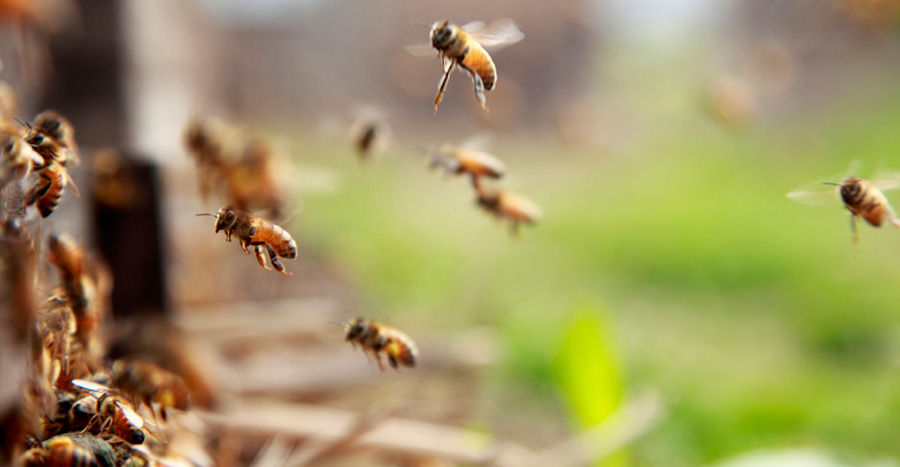
Foraging bees return to their hive with pollen and nectar.
The final stage in the life of a worker bee is the role of forager, and this role starts around the twentieth day of life and lasts until the bee dies. How long this is can be widely variable depending on the time of year and foraging conditions. Foraging bees go out of the hive and bring back a number of things to make sure the hive has everything it needs to prosper. Sometimes they go out and find water, suck it up into their "crop" or honey stomach and bring it back to help regulate temperatures inside the hive and feed baby bees. Sometimes they collect nectar, which is the primary building block of honey. Foragers also collect pollen as they fly from blossom to blossom, packing it on the pollen baskets of their hind legs, then sticking it in the comb cells to be eaten later. As bees forage, they encounter predators and experience wear and tear of their bodies and wings. Eventually, they either wear out -- or are killed or eaten, and new bees take their places.


Comments